Showing posts with label Home School. Show all posts

Saturday, June 23, 2012

Reading Eggs Online Reading Program for Kids

I tend to be skeptical about digital learning experiences for my kids. We own a couple of computer "learning" games and I find my kids mainly learn how to use a computer but not so much reading, writing, or math.

So when I saw the opportunity to review Reading Eggs, an online learn to read program, I hesitated.

Could Reading Eggs really help my kids learn to read?

To help me review the program Reading Eggs offered a free trial subscription for one of my children. If it didn't work, I wasn't out any money so I agreed to do the review.


My older boys (ages 7 & 9) are proficient readers already, thanks to traditional methods. My girlie (5 yrs) will start kindergarten this fall and has been asking me to teach her to read, so she's the one I picked for the review.

As you can see from the infographic, there are several levels where you can begin your child. I started Ellie at 'Ready for School' beginner. She already knew the sounds each letter makes but I wanted to reinforce that knowledge before she learned to combine sounds.

Ellie is learning to read with Reading Eggs.

Ellie has been playing Reading Eggs online for about a month. She has progressed to level 40 which requires reading basic sound families (such as AT- cat, bat, sat, etc.) and recognizing a few sight words. For the most part she is really reading the words, not just guessing at the correct answer.

I like that the program focuses on phonics but also uses some sight words. I believe learning to read requires both. I also like that she can't just guess the pattern or answer in order to progress. The program is repetitive enough that she really does have to figure out the correct answer.

Ellie's having fun and learning to read with Reading Eggs. That's win-win for me.

Is Reading Eggs worth the cost?


I'm not sure if Reading eggs is worth the fee for your family, only YOU can make that decision. There are 3 different fee levels: $9.95 per month; $49.95 for 6 months; $75.00 for a 12 month subscription - for ONE CHILD.

You can add additional children to your account for 50% off. But when you have 4 kids, that's a lot of money!

I recommend purchasing a Reading Eggs subscription if:

  • you have a struggling reader who needs some extra help.
  • you want to keep your child's reading skills sharp during the summer school break.
  • your child loves computer games and you'd like him to learn something during the hours he spends clicking the mouse.

As a home school mom who has taught 2 children to read, I highly recommend the Reading Eggs online learn to read program. Sign up for the FREE 14 DAY TRIAL and see if it's a good resource for your family.


Have you used Reading Eggs? If so, what was your experience?


Disclosure: I received a free subscription for one child to aid me in reviewing the program. The opinions stated are my own and not influenced by anyone.


Linked to:

Hip Homeschool Hop Button

Thursday, January 5, 2012

How to Home School with a Toddler in the House

In September 2008 my oldest child started kindergarten. It was a momentous day for us. I think our school day lasted a whole hour back then. Partly because that's all the attention span he had and partly because I had a house, 2 year old, and 3 year old to look after.


One month later we added a newborn to our home and our home school went on unofficial vacation for a couple of months!

Thankfully by the time September 2009 rolled around I had learned a few lessons in managing 4 small children, a home and school!

Saturday, November 26, 2011

Kid's Christmas Activities and Books

What do reindeer ornaments, no-bake spiced ornaments, The Grinch who Stole Christmas and The Muppets Christmas Carol have in common? They are all on my 30 Days Kids' Christmas Activities and Books plan!

Last month's Thanksgiving kid's activities and books plan worked so beautifully that I decided to make a month-long plan for Christmas. We didn't do or read everything I had on the plan in November, but we did most of it. And I count that as a success!

My ideas for December include a variety of children's Christmas craft activities, reading children's Christmas books, and watching our favorite kid's Christmas movies.

I'll be blogging most of it and linking it all on this post. Each week I'll give you a sneak peek at what's coming up and then on the day the post publishes I'll add the link here.


Week 1

Week 2

Week 3
 Week 4

Merry Christmas from my family to yours!

Updated 12.31.11: Due to unforeseen circumstances of tummy bugs and migraine headaches I was unable to complete the posts for week 4. I'll be sure and start with those for 2012! {smile}
     
To make sure you don't miss a post subscribe to the Stephanie's Mommy Brain feed for a reader or by email.

I'd love for you to tell your friends about 30 Days of Christmas Activities and Books. Feel free to link to this post or place a button in your sidebar. Use the button above or the one from my sidebar.

Friday, November 18, 2011

A Silly Kid's Thanksgiving Poem

After reading silly Thanksgiving poems this week, we pulled out our Thanksgiving journals and my children tried their hand at writing an original poem of their own.

Hilarious doesn't begin to describe it. See for yourself. An original poem by William, age 8:


In case you need an interpreter:
The turkey said to the pie, "You are dry."
The pie said to the turkey, "Your future looks murky."
Can you write an original Thanksgiving poem?

Be sure to like Stephanie's Mommy Brain on Facebook where I'm sharing more Thanksgiving tips and links throughout November.

More Thanksgiving Kids Activities and Books Posts

Linked to:
Hip Homeschool Hop Button

Tuesday, November 1, 2011

Thanksgiving Kid's Activities and Books

I believe Thanksgiving is an important holiday for my children to understand and celebrate. To make sure I put action to my words this year I put together an activities and book plan, or unit study in the language of home schoolers.


This is a list of all my posts related to Thanksgiving children's activities, children's books, and anything else Thanksgiving that I share throughout November. My plans are quick and simple.  For the most part they don't require a lot of preparation or supplies.

I hope you are inspired by our activities. One activity a week is a great place to start!


Be sure to like Stephanie's Mommy Brain on Facebook where I'm sharing more Thanksgiving tips and links throughout November. 

Linked to:
Tip Junkie handmade projects Hip Homeschool Hop Button Women Online

Tuesday, October 18, 2011

Kid's Thanksgiving Activities (Unit Study)


I love Thanksgiving! It's my favorite holiday. I love how it's just about family and friends sharing a delicious meal and remembering our blessings. There's no pressure to find the perfect gift, no debate over how secular or how religious to be, no hustle and bustle. It's just enjoying your loved ones and a big hunk of pumpkin pie.

Last week I pulled out my Thanksgiving children's books and realized I've accumulated quite a collection. (By the way, if you can only buy one Thanksgiving book make it Thanksgiving: A Time to Remember by Barbara Rainey. It is the best book ever!!) As I looked at the pile of 18 books, and 1 CD set, I realized I needed a reading and activity plan in order to get the best use of my books.

Being a home school teacher, it didn't take me long to write out Thanksgiving lesson plans (linked to my plan) for the month of November. A couple of years ago I made a similar list of children's Thanksgiving activities and it really helped us stay on track throughout the month.

This year's Thanksgiving unit study includes a couple of craft activities (I'm not crafty so there aren't many), writing prompts, drawing ideas, a list of websites with more ideas and a list of the Thanksgiving themed books I own.

Please understand that my plan is geared for my family - our weekly schedule and personalities. It might work for your family as it is, or it might need some tweaking, but I hope you'll find something in it that you can use! You'll also notice that it's only Monday - Friday. That's because I'm using this study for our History/Civics curriculum this month.

edited November 5, 20011: If you look at the plan you'll see "Make hardtack" and a link to an online recipe. I do NOT recommend you make this recipe. Seriously. It was as hard as a hockey puck. Someone could chip a tooth!

Do you have a favorite Thanksgiving tradition or book that's not on my list? Please share!!

Be sure to like Stephanie's Mommy Brain on Facebook where I'm sharing more Thanksgiving tips and links throughout November.
* More Thanksgiving Kids Activities and Books Posts 

Tuesday, August 30, 2011

3rd Grade and 1st Grade Home School Curriculum

The favorite question among home school moms at this time of the year is, "What curriculum are you using?" Being a normal home school mom, I've asked and answered that question numerous times during the last month.

I realize not all of my readers are home schoolers but most are moms who are interested in their child's education. Much of the curriculum we use would work great for a child that is falling behind in an area or is bored and would like a little advanced work during school breaks. I hope you find something useful in my reviews of our curriculum.

During the 2011-2012 school year I am teaching a 3rd grader, a 1st grader, a Pre-Kindergarten 5 and a (almost) 3 year old. How I do all of that and stay sane is the topic of another post; for now I'm limiting this post to my two big boys: 1st and 3rd grade.

Rhode Island law requires that I include: reading, writing, geography, arithmetic, civics, English, health and physical education. My boys use the same curriculum for every subject except Language Arts. This makes it MUCH easier for me!

Science

You'll notice that science is NOT in the list of required curriculum; and "experts" wonder why we can't keep up with other developed nations academically! Regardless of what our state requires, we believe science is an important subject to teach.

This is our 3rd year using Apologia's Exploring Creation curriculum. We LOVE it! We are studying land animals which fits well with our history curriculum and makes for easy field trips to area zoos.


Arithmetic

Last year we used Saxon, and hated it. Saxon is one of the gold standards for home schoolers. It's based on a spiral education philosophy, which I realize now does not work for us. This year we are using Math U See, and loving it!

Math U See (Alpha and Beta) is based on a mastery philosophy, meaning you don't move on to the next skill until you've mastered the current one. The teacher's kit comes with a book that explains how to teach each skill and a DVD of the author teaching each lesson to a classroom of students. The student workbook and test/activity book includes plenty of practice problems to insure the student masters the skill.

As expected, it is designed for the visual learner. I recommend you purchase the block manipulatives as they are the foundation of each lesson. My oldest is definitely a visual learner and my #2 boy is part visual and part kinesthetic (learn by doing) so both boys enjoy "playing" with the blocks during their math lesson.

Because we had such a terrible time with Saxon for the last two years, I decided to start both boys with the Alpha (or first grade) book. My plan is to finish Alpha the first semester and Beta (2nd grade) the second semester. My #2 boy is very math minded so I don't think he'll have difficulty keeping up. My 3rd grader is more word minded so doing 1st and 2nd grade work is OK for him.

Health and Physical Education

Both boys are involved in Cub Scouts this year. If you know the Cub Scout curriculum you know that they have a health component. We are looking into putting them into gymnastics and they will play baseball again in the spring.

Civics

I am combining civics and geography by using history and literature unit studies. I have purchased Soli Deo Gloria's Lewis & Clark and Westward Ho! Also, Progeny Press's Little House in the Big Woods, Little House on the Prairie and Farmer Boy study guides. In looking over each of these guides I think they are good starting point but I will be supplementing with other materials and children's books.

Language Arts

Handwriting Without Tears comes highly recommended so I'm giving it a try this year; and LOVING it! My 3rd grader is a leftie with dexterity issues. His penmanship is difficult to read so we are using the 1st grade workbooks with the hope of moving into 2nd grade next semester. He is NOT advancing to cursive this year.

My 1st grader has beautiful handwriting thanks to hours and hours of drawing and building with Legos. Unfortunately he's picked up a couple of penmanship bad habits so I'm hoping to correct those this year.

Handwriting Without Tears is designed to be very hands-on and offers a lot of extra multi-sensory components. I bought the teacher's guide and student workbooks as well as the Rock, Rap, Tap & Learn CD. My guys enjoy listening to the CD and dancing around our living room together. You could say we get our P.E. in while listening to handwriting. :)


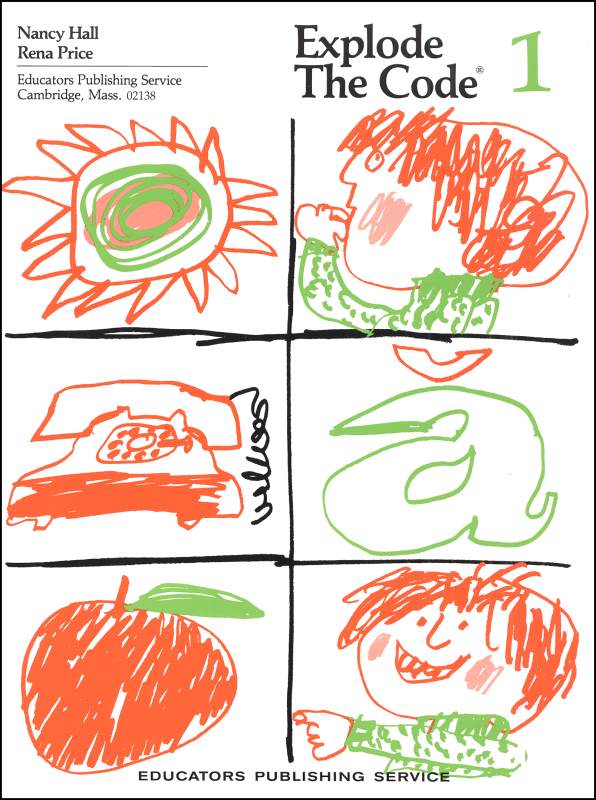
Explode the Code is a fantastic phonics based workbook series. We are using 2-3 workbooks each year but you can go as fast or as slow as you want. I used this program last year to teach my #2 boy how to read and I'm using it again this year to begin teaching my 5 year old daughter to read. The boys are in different workbooks this year because Will's reading level is several grades ahead of Ben's. In fact, Will (3rd grade) finds the workbook super easy but I want to make sure he has a firm understanding of phonics.


Alpha and Omega LifePACs language arts is an all inclusive program. It covers handwriting, spelling, phonics, grammar rules and a few other skills that fall under language arts. I am only using this with Will (3rd grade). I think of it as my "security blanket" to make sure I don't miss anything for Will but I feel that it's kind of "a mile wide and an inch deep." It covers so many different areas that I feel Will doesn't get enough practice with key skills, which is why we use the other programs as well.


Write About Me/Write About My World is published by EPS School Specialty Publishing, the same publisher for Explode the Code. I am using these consumable workbooks with Ben (1st grade). Each page gives him a writing topic and space to write. It's a good introduction to grammar rules and creative expression.


As you can see I use a little bit of everything from a lot of different publishers. This is our 4th year of homeschooling and I've finally figured out what works best for me and for both of my boys. There are a couple of other workbooks and items we will add in as time allows over this year but for now this is our core curriculum.

So, what curriculum are you using?

* 2010-2011 Homeschool Curriculum for Kindergarten and 2nd Grade.

Wednesday, August 24, 2011

Why home school?

"Wow. I could never do that!"

I assume from this statement that strangers, acquaintances and friends believe I am Super Mom with an endless supply of patience, creativity, and energy. After all, how else could I home school a 3rd grader, 1st grader, Preschool 5 year old and a Preschool (almost) 3 year old?

Let me dispel the myth right now.

Home school moms are not Super Moms. We are not endowed with super-patience, super-creativity or super-energy. We are ordinary moms who yell at our child when he calls his sister a derogatory nickname (It's unfortunate that smelly rhymes with Ellie.) and use a DVD to babysit our children while we sneak in an afternoon nap. Maybe that last one is just me.

If we're just regular run-off-the-mill moms, why do we choose to home school? Why do we postpone careers, give up lunch dates with other moms, and add lesson planning to our mom workload?

I won't presume to speak for other home school moms but I'll share with you why I made this choice.*

First, I believe home schooling is the best way for my children to learn my values. My children are with me almost 24/7 which allows for countless opportunities to instruct and model my beliefs. Also, I don't have to compete with differing attitudes and ideas of a classroom teacher.

Please don't misunderstand me. I am not anti-teachers. My mom worked as an elementary teacher for years and I trained to be a high school social studies teacher. Also, I am NOT saying that parents can't pass on their values to publicly/privately schooled children. I am saying it is harder and requires a great deal of intentionality.

Next I enjoy the home school lifestyle. I determine what time we start our day, not a bus schedule. I plan our school calendar to include breaks when it's convenient for us. And, best of all, we take frequent field trips to nearly deserted museums and aquariums!

Finally, I believe homeschooling makes it easier to shelter my children from information and attitudes that they are not prepared to handle. As my children grow and mature I equip them to handle the situations of life that they will face. That's my job as their mom. It's also my job to shelter them from situations that they are not mature enough to understand or respond to correctly.

Homeschooling doesn't mean I control every conversation, every relationship or every interaction my children have. Instead, it reduces the list of unknowns to a manageable size. Instead of a school day's worth of interactions to discuss with my child I only have a Cub Scout's meeting (2 hours) worth to talk about. Like I said before, I'm NOT saying it isn't possible to shelter a publicly/privately schooled child. I am saying is that it is harder and requires a great deal of intentionality.

So, why do I home school? Because it makes teaching and training my children easier for me. Not to mention homeschooling allows me to stay in pajamas until noon avoid crazy pick-up/drop-off school lines.

Disclaimer: I understand that some of the above is controversial and you may have strong or negative thoughts and feelings about what I've shared. Please understand you are not going to change my mind. However, we can agree to disagree and have a friendly discussion in the comments. Unfriendly or unkind comments against homeschooling or against schools/teachers will not be published.


*I did not make the educational choice for my children alone. My husband and I decided together to home school. We both agree on the above reasons, well, maybe not the pajama one. :)

Wednesday, April 13, 2011

Home School Curriculum for Kindergarten and 2nd Grade

During a conversation this morning on my personal Facebook account I was asked about the changes I'm making in our curriculum and what I recommend for visual learners.  Facebook does NOT give me enough space to share my thoughts on the topic so I looked for a post about our curriculum this year.  Imagine my surprise that I never shared that information!

So for my Facebook friends, homeschooling readers, those considering home schooling, and the just plain curious I give you the SMB home schooling curriculum 2010-11.

This year I have a 2 year old, 4 year old, kindergartener, and 2nd grader.  I'll group everything by ages, sort of.

2 Year Old:

I use ... nothing.  He's only 2!  I don't intentionally work with him on shapes, colors, letters, numbers.  Nothing.  Poor child.

However, we do count a lot as we clean up, we sing the Alphabet song as we go about our business.  We talk about colors as he gets dressed.  School for him is just part of our daily life.  It must be working because the boy can count to 10, knows random letters, and can tell you the correct color of a crayon about half the time.

It helps that he's #4 and listens to the other 3 all day long.

4 Year Old:

Ellie is ... well, my girlie.  She's only 18 months younger than Ben and likes to keep up with him.  So once school started in the fall she needed her own school books to use while "The Brothers" (as we call them) did their school.

My goals for Ellie are very low:  learn letters and their sounds, develop eye/hand coordination for writing, be able to write her name.

My friend, Stephanie, blogged about using Get Ready for the Code, Get Set for the Code and Go for the Code with her daughter.  It sounded like a great fit for us this year.

I bought all 3 for Ellie and she LOVES them.  In all honestly, I only spend about 5 or 10 minutes working with her.  But she faithfully pulls our her "Fish Book" and now "Dinosaur Book" and works her pages until The Brothers are done or playing with Sam sounds like more fun.  It keeps her occupied and she's gradually learning the sounds letters make.  I'll share more about the Code books in a minute.

I also bought Ellie a couple of general preschool workbooks from Wal-mart.  They are only $10 and have everything a child needs at this stage.  We're using Big Preschool Workbook Ages 3-5 published by School Zone.  It's colorful and fun for her to use.

Kindergarten and 2nd Grade:

Yes, most of what my boys do is exactly the same, except for language arts.  I just require more effort from Will (2nd grade) than I do Ben (K).

Science:  Apologia's Exploring Creation Flying Creatures.

We LOVE this series!  We studied Swimming Creatures last year and will use Land Animals this fall.  The textbook is professionally written, edited and bound.  It contains lots of diagrams and COLOR photographs (which is rare for HS materials). 

The material is written from a creationist world view so you don't have to deal with the theory of evolution, which I like at this early stage.

This year we bought the notebooking journal that goes with the textbook but I don't think we will for the fall.  After a few chapters it started to feel like busy work instead of reinforcement.  I hate busy work.  If you are into lapbooks I've seen companion lapbooks for sale as well.

You may be wondering how I do this with both boys.  Actually, all 4 children participate in science.  We all sit on the living room floor or couch while Will and I read the chapter aloud to everyone.  We talk about what we are learning and looking at the pictures.  The reading level is just a little challenging for my 2nd grader which is good for him.

I also supplement the textbook with picture books and non-fiction children's books from our library that relate to our current chapter.  This aren't a formal part of our school.  They are just available for my kids to pick up and read for fun.

Math:  Saxon Math. 1st Grade.  

I realize Will is in the 2nd grade but we just can't seem to get through the 1st grade textbook.  Saxon is VERY hands on and basically I don't like it.  It doesn't work for me.

We'll be throwing it out and trying something new this fall.  I'm open to suggestions that are mastery focused and NOT hands on or requires tons of help from mom.


History:  Early American History (Primary) published by Beautiful Feet Books.

This literature based history course uses a teacher guide book and over a dozen children's picture and chapter books.  I love the approach.  Not loving the guide book. 

According to the website this guide is intended for K-3rd grades.  After about a week of making me crazy I threw out the guide book (well, not literally.  I did spend good money on it!).  I felt like the concepts we're too high level for my children and the activities of journaling and writing were too involved.

So, we read the books that came in our jumbo pack.  I also found tons more children's books on the same topics at our local library.  We watched Liberty's Kids on NetFlixs.  And took field trips, after all, we live in NEW ENGLAND!

If you look at the intermediate level package it uses many of the same books from the primary level.  I'm holding onto the guide and I think we'll revisit early American history in a couple of years.

Phonics:  Explode the Code

Both boys have been going through these workbooks.  Will's ready level is way above grade level but I felt he needed to reinforce the phonics rules.  He whizzes through the pages.  Ben WORKS through his.

Ben started the year knowing letters and sounds.  He's now on book 4 (in April) and reading simple readers.  The switch hasn't flipped yet where reading is like breathing for him but he's close!

I highly recommend Explode the Code.  The black and white illustrations are VERY engaging and fun, especially for boys.  Each lesson is 10 pages long but you can take that as fast or as slow as you want.  It's phonics based but also includes some sight words.  There are 8 workbooks with 6 workbooks that are 1/2 books, meaning if your child needs more help with the concepts in book 4 then you move to book 4 1/2 instead of book 5.  The boys will finish this series next year.

Handwriting:  Draw. Write. Now

I highly recommend Draw. Write. Now.  These are drawing and handwriting non-consumable books that come in a set of 8.  You can buy them individually but if I love having the whole set.

The premise of Draw. Write. Now. is that children dislike practicing the same letter over and over on a worksheet.  So instead, give them a picture to draw with 4 sentences to copy that describe the picture.  The motor skills are still being developed but it's a lot more fun!

I recommend buying the notebooks that go with the series.  On one page is a blank box for the drawing and on the facing page are manuscript lines for their writing.  It's fun to have all the pictures together and see the development from the beginning of the year to now.

Also, we didn't work our way through the books chronologically.  I chose the day's picture based on what we were studying in history and science.  This only worked because I have the whole set.  I've also found similar how-to drawing books and made up my own sentences when our lessons didn't have a good example in D.W.N.

Language Arts:  Alpha Omega LifePacs Grade 2.

Will is using this set of 10 workbooks.  He just started book 4 (in April) so he'll be finishing it up this fall.  Will is an independent learner.  He doesn't need, or like!, a lot of direction from me so these workbooks have been great for him this year.  The workbooks include spelling, grammar, reading comprehension, and handwriting.  An all in one if you will.

LifePaks worked great for us this year as I adjusted to teaching 2 (sort of 3) kids, running a household and blogging.  If you need a language arts that doesn't require a lot of time and attention from mom then I recommend LifePaks.

For my non-homeschooling friends that have made it this far, I recommend Draw. Write. Now for children who enjoy drawing or need a little help developing their fine motor skills over the summer.  I also recommend the Code books for preschoolers learning to read and elementary students that need a little extra help over the summer.

What curriculum have you used, loved or hated this year?

Tuesday, April 12, 2011

Geography Lessons with Evan-Moor

As you probably know we are a home school family.  But this is not a home school blog.  I know that many (most?) of my readers aren't homeschoolers BUT I also know that many of you are teachers or parents concerned about your child's education.  So from time to time I review products and curriculum that we use for school.

Today is one of those times.  A few weeks ago I received an email from Timberdoodle Company asking if I would be interested in reviewing their Geography curriculum by Evan-Moor.  Well, since I plan to teach geography this fall I hopped on the opportunity!!

~~~~~~~~~~~

Beginning Geography (Grades K-2), published by Evan-Moor.

Beginning Geography is exactly what it says - basic concepts for map skills, landforms & bodies of water, and continents & oceans. 

My kindergartner and second grader had no trouble completing the worksheets for the map skills.  Both boys love pouring over maps and finding airports, cities and other special sites so these worksheets provided reinforcement for skills they are already developing.

I am most excited about the third section - continents and oceans. There are reproducible maps of each continent as well as all seven continents together.  I think my boys will enjoy using these worksheets as we learn about world geography.

~~~~~~~~~~~~~


Daily Geography Practice Grade 3, published by Evan-Moor.

Daily Geography Practice workbooks are based on National Geography Standards.  The book is broken down into 36 weeks of instruction with each week focused on a different standard.  A mini-lesson plan and answer key is given for each week.  Students are expected to answer 2 questions each day for a week as part of the lesson.

Honestly, national standards don't concern me.  Our state does not require testing.  At this early stage of their education, I'm more focused on growing my children's interest in the world around them than I am that they be able to keep up with other children in their grades.  However, I realize that some find the national standards reassuring and an easy guideline for what to teach and when.

I do believe Daily Geography is useful but I don't see me using it the way it's intended.  Answering just 2 questions each day would frustrate my children.  Also, I don't see us using this as our sole geography curriculum but instead as reinforcement with other products.

Daily Geography covers 2 basic elements - map skills and the United States.  I am most excited about the United States segment.  Not all of the States are included but those that are show interesting maps and information.  Like Beginning Geography this book is also reproducible and contains transparencies for all of the maps (not a feature that I need but would be useful for classroom teachers).

My one major criticism of these books is kind of nit-picky. All of the pages tear out but they don't have holes punched in them for a binder.  This means once I've pulled them out I'll have to put them in file folders or punch holes myself.  I hate file folders.  Like I said, it's nit-picky and totally a personal preference.

Overall I recommend this curriculum for home schoolers looking to supplement their other curriculum with worksheets and maps

I also recommend it for public school teachers looking for supplements for their classrooms and for parents of public school kids looking for fun and educational activities at home.


Disclosure:  Thank you to Timberdoodle Company for the free copies of these two books to aid in my review.  The opinions expressed are my own and not of Timberdoodle Co. or anyone else.

Monday, March 14, 2011

Teaching Children Hospitality as the Hostess

Have you ever viewed a play date, birthday party or special event as more than just a fun occasion for children?

My four year old daughter, Ellie, recently hosted a play date for her friends from our home school co-op. Because I want Ellie to one day be an excellent hostess I took a little extra time and included her in all of the hostess tasks*.

Ellie (in the denim jumper) with her friends

Please read the rest of the article at Offering Hospitality.

Tuesday, February 1, 2011

Benjamin Franklin Children's Book Recommendations (Part 2)

"He that scatters thorns, let him not go barefoot." - Benjamin Franklin

I have a confession to make - I'm a nerd.  There, I admitted it.  Why am I a nerd?  Because I actually enjoy history and learning about people and events of the past.

My favorite way to learn and teach history (especially American history) is to read children's books and take field trips.  As I mentioned last week, general Benjamin Franklin children's book biographies abound at my local library, but I did find a few that focused on specific events our portions of his life.

Here are my 5 favorites:

Picture Books

Ben Franklin's Glass Armonica by Bryna Stevens.  Illustrated by Priscilla Kiedrowski.  Published by Carolrhoda Books, 1983.

Did you know Franklin invented a musical instrument that both Mozart and Beethoven composed music for?  I didn't either.  Franklin created the instrument by using different sized glass bowls laid on their sides.  Think of running your finger around the rim of a crystal glass and you'll get the idea behind Franklin's Armonica.

Stevens explains why Franklin developed the armonica.  She then describes how the armonica was built and it's popularity in Europe.  I love the focus on such an obscure detail from Franklin's life!

***********

The Hatmaker's Sign:  A Story by Benjamin Franklin.  Retold by Candace Fleming.  Illustrated by Robert Andrew Parker.  Published by Orchard Books, 1998.

After spending his time and energy drafting the Declaration of Independence, Thomas Jefferson listened to the Continental Congress debate and change his document.  His friend, Benjamin Franklin, noticed his frustration and anger at all of the alterations and told Jefferson a parable about a hat maker who wanted to have a sign made for his shop.

Fleming does an excellent job of retelling Franklin's story and Parker's illustrations keep the reader visually interested.  Again, the book highlights a little known event from Franklin's life.

**********

How Ben Franklin Stole the Lightening by Rosalyn Schanzer.  Published by Harper Collins, 2003.


Schanzer gives an overview of Franklin's life in the first half of this book.  Then during the second half she focuses on Franklin's experiments with electricity and his famous kite flight.  My favorite part is the explanation of how the kite experiment worked.  There was more to it than lightening striking a kite but you'll have to read the book to find out for yourself.
**********
Early Readers

Ben Franklin and the Magic Squares by Frank Murphy.  Illustrated by Richard Walz.  Published by Random House.

Ben Franklin is bored while listening to the Pennsylvania Colonial Assembly debate and discuss various bills.  In order to stay awake he invents a new mathematical puzzle.  The puzzle is a grid like ticktacktoe with numbers arranged so that each row, column and diagonal row add up to 15.  (It reminds me of Suduko puzzles.)

As a "Step into Reading" book, a student can practice his reading skills while learning about Franklin and a fun math puzzle.  He'll be having so much fun he won't even notice he's learning something.  

*********

Ben Franklin and His First Kite written by Stephen Krensky.  Illustrated by Bert Dodson.  Published by Aladdin an imprint of Simon & Schuster, 2002.

A level 2 "Ready-to-Read" book from the "Childhood of Famous Americans" series this book provides a glimpse of the young Ben Franklin.  Even as a child Franklin invented contraptions and conducted experiments.  Here we learn that young Ben wanted a way to swim across the pond faster, so he used a kite to pull him across the water.  Sort of a precursor to wind sailing.

I think this book inspires children to think creatively and look for solutions to everyday problems in their lives by telling the story of a real boy and his real experiment.  A fun read for energetic and inquisitive boys!


I love learning new things and these books have been a ton of fun!!  It's too bad we don't live close enough to Philadelphia to visit any of the Benjamin Franklin related tourist sites!

Now that I've confessed my nerd status, I want to know - are you are nerd, too?  Do you enjoy reading historical children's books?  What about non-fiction?

You might also be interested in:

Tuesday, January 25, 2011

Benjamin Franklin Children's Book Recommendations (Part 1)

  • "When the well's dry, we know the worth of water."
- Benjamin Franklin

Several weeks ago I discovered that January 17 is Ben Franklin's birthday.  This fact, coupled with our study of early American history, led me to restrict our library books to just Benjamin Franklin (and bats for science).

When I say restrict, I'm talking almost obsession.  To the point that I maxed out my library's online reservation/hold system AND my husband asked me if I really needed that many books.  Why, yes, I did! 

After wading through 25 children's books about Benjamin Franklin, we have learned that he lived a fascinating life.  Printer, scientist, inventor, post master, politician, Founding Father, ambassador, musician and author were just a few of his titles.

Most of the books I discovered are really good but they also tend to be broad biographies.  Those have their place but I wanted to read details about specific parts of Franklin's life.  That's partly why I ended up with so many books.

Because I love to learn about great children's books from other moms, I'm sharing with you my favorite books about Benjamin Franklin.  I ended up with 12 favorites so I'm dividing them into 3 different posts.  First up...

General Biography - Not quite picture books but not chapter books either.

What's the Big Ida, Ben Franklin? by Jean Fritz.  Illustrated by Margot Tomes.  Published by Penguin Putnam, 1976.


Fritz has written many of the "gold standard" colonial history children's books.  It tells of Franklin's life from birth to death and has excellent illustrations.


                   *************

Benjamin Franklin by Ingri and Edgar Parin d'Aulaire.  Published by Doubleday, 1950.  Reprinted (?) by Beautiful Feet Books.

Another "gold standard" among historical children's books.  The version I own has some colored illustrations and some black and white.  This is by design to go along with the curriculum we purchased from the publisher.  

My favorite part of this book is the short proverbs from Franklin on each page.  I think these quotes, such as "A sleeping fox catches no poultry," come from Franklin's Poor Richard's Almanac.

*************

The Amazing Life of Benjamin Franklin by James Cross Giblin.  Illustrated by Michael Dooling.  Published by Scholastic Press, 2000.


I love the illustrations in this Franklin biography!  The pictures almost look like photographs and capture the culture and emotions of the colonial period perfectly. 


Activity Books - Even before we started homeschooling I liked to combine books with activities and field trips.  You don't have to home school to include this kind of fun in your family activities.


Each chapter gives a snippet about a specific time or event in Franklin's life.  Also included in each chapter are "Words to Know," "Fun Ideas to Try," and actual experiments.  The experiments and activities relate to the biographical information in each chapter.  

One fun experiment I'd like to try is to turn a regular pizza delivery box into a solar oven and bake cinnamon apples.  Having our yard covered with snow for almost a month has prevented us from testing this activity but I'm sure it would work in the summer.

I will say that I don't think the title is completely accurate.  I thought the experiments would actually be Franklin's but they are not.  So in that sense the book didn't meet expectations but other than that I highly recommend it!

*************
Benjamin Franklin American Genius:  His Life and Ideas with 21 Activities by Brandon Marie Miller.  Published by Chicago Review Press, 2010.

This book is similar in format to the one just above, however, I think it is targeted for slightly older students of history.  Also, the activities are not specifically related to experiments.  Both books are excellent and different enough that owning both would be fun.

Miller includes a great deal of biographical and historical detail.  I would suggest students 9 or 10 years old as a good starting point but I think the info and activities would interest even a high school student.  I'd really like to try the dipping candles activity, Franklin's father was a candle maker so learning to make candles would fit well with the narrative, but I'm afraid my little guys might get burned.  Guess I'll just have to check out this book again in a few years.


What do you know about Benjamin Franklin?

Next month's book focus: George Washington (in honor of President's Day).

You might also be interested in:

Wednesday, June 9, 2010

The Best Books for a Road Trip with Children

How do I keep 4 children under the age of 7 occupied during a 10 hour road trip?

I give them books!!!

But not just any books.  I give them Discover America State by State books by Sleeping Bear Press.

While planning our recent trip to D.C. I wanted to include books in our trip.  So I decided it would be fun to use the state themed alphabet books by Sleeping Bear Press for the 7 different states we drove through (RI, CT, NY, NJ, DE, MD, VA).


With the help of the Rhode Island library system I managed to collect the alphabet book for each state and the city of Washington, D.C.  Then on our trip I put the books in a box between Will and Ben.  They could pull the books out anytime they wanted and read all about the state we were currently traveling through.


And there's a bonus with these books.  Each one has an online study guides that you can download and print!  So not only can a child read about Delaware, he can work a word search about Delaware.  


I found the Sleeping Bear Press State by State alphabet books worked well for keeping my children entertained our a long road trip.  It almost makes me want to take another trip so we can get some new books.  Almost.

Do you use books to keep your children entertained on a long road trip?  If so, which ones?

Disclaimer:  I have NOT received any compensation or been requested to write this review.  The opinions and idea are all mine.  I truly love Sleeping Bear Press and think everyone should love them, too.

Tuesday, June 8, 2010

S is for Smithsonian by Marie and Roland Smith

S is for Smithsonian: America's Museum Alphabet by Marie and Roland Smith.  Illustrated by Gijsbert van Frankenhuyzen.  Sleeping Bear Press, 2010.

My family visited the Smithsonian National Air and Space Museum (Udvar-Hazy Center) on a recent trip to Washington, D.C.  While there I quickly purchased S is for Smithsonian as the perfect way to remember our trip.  The book does not disappoint!

From the Wright Flyer to Dorothy's ruby slippers, reading this book gives you snapshots of exhibits in the 19 museums and zoo that comprise the Smithsonian Institution.

When you read "S" you learn that an English scientist named James Smithson willed his fortune to the U.S. with the stipulation that we create the "Smithsonian Institution, an establishment for the increase and diffusion of knowledge among men." Very interesting!

One of my favorite parts of the book is actually on-line.  A free study guide is available for you to download and print.  The guide contains worksheets and follow-up activities for you to use after reading the book and visiting the museums (or viewing the museum website via the link provided).

If you are planning a visit to a Smithsonian Museum, or just want to learn more about them, I highly recommend you pick up a copy of S is for Smithsonian!!

Tuesday, June 1, 2010

2010 Summer Reading Programs for Kids

Want to receive a free book?  Free movie admission?  How about $10 in a savings account?

Check out these 2010 Kids Summer Reading Programs to see if they're right for your child.

Read 8 books and receive a free book from Barnes and Noble.

Earn a $3 gift card from Half Price Books for each week a child reads 15 minutes a day.  Unlimited number of weeks!!!

Receive free admission to a select children's film when a child presents a book report at a participating Showcase Cinemas, Multiplex Cinemas or Cinema de Lux box office. Accompanying parents and children under six receive free admission and do not need to submit a book report. Program begins July 7!

Meet the challenge of reading five books, to be eligible for a chance to win a slammin' summer prize package from Pizza Hut.  
Includes swim gear, books, games, gift cards, and more!

Read 10 books and $10 will be deposited into 
a new or existing Young Saver account at TD Bank.

Read 10 books and get 1 book (from their list) free at Borders.

Do you know of any other Kids Summer Reading Programs that give free incentives? 
Related Posts Plugin for WordPress, Blogger...